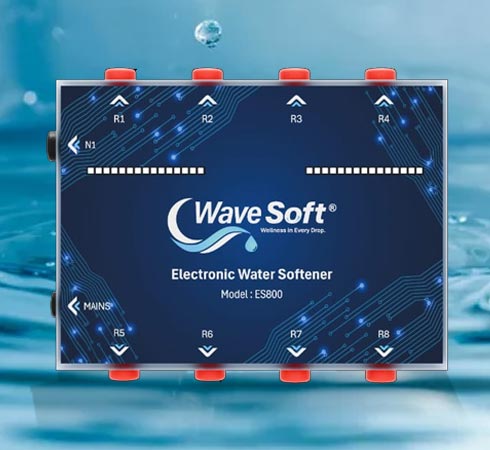
An Electronic Water Softener is a device designed to reduce the effects of hard water by preventing the build-up of scale in pipes, appliances, and fixtures. Unlike traditional salt-based water softeners, or Magnetic water softeners do not remove calcium and magnesium from the water. Instead, they use electromagnetic waves or radio frequencies to alter the behaviour of these minerals, preventing them from sticking to surfaces.
How It Works
The device is installed on the main water supply line.
It generates an electromagnetic field or radio frequencies.
This field alters the shape and charge of calcium and magnesium ions, reducing their ability to form lime scale.
The treated water continues to flow through the plumbing, minimizing scale deposits while retaining the beneficial minerals.
Benefits of an Electronic Water Softener
Prevents Scale Build-up – Protects pipes, water heaters, and appliances.
Low Maintenance – No salt refilling or resin cleaning required.
Eco-Friendly – No wastewater or chemicals used.
Retains Healthy Minerals – Unlike salt-based systems that remove them.
Easy Installation – No plumbing modifications needed; often a simple clip-on device.
Limitations
Does not remove hardness minerals, only alters their behaviour.
Effectiveness may vary based on water hardness and flow rate.
Might not be as effective as traditional softeners in extreme hard water conditions.
The working principle of an Electronic Water Softener is based on electromagnetic induction and does not involve a direct chemical reaction. However, the process influences the crystallization of hardness ions (Ca²⁺ and Mg²⁺) in water.
Chemical Principle
Hard water contains calcium (Ca²⁺) and magnesium (Mg²⁺) ions, which form insoluble deposits of calcium carbonate (CaCO₃) and magnesium carbonate (MgCO₃) when they react with carbonate ions (CO₃²⁻):
Natural Scale Formation Reaction
Ca²⁺ + CO₃² ---> CaCO₃
Mg²⁺ + CO₃² ---> MgCO₃
These solid deposits accumulate in pipes, appliances, and fixtures, leading to scaling.
Effect of an Electronic Water Softener
An electronic water softener generates an alternating electromagnetic field (EMF) around the water supply. This field changes the structure of calcium and magnesium ions, preventing them from forming hard scale.
Formation of Aragonite Instead of Calcite
Normally, calcium carbonate (CaCO₃) crystallizes as calcite, which is hard and adheres to surfaces.
Under an electromagnetic field, CaCO₃ crystallizes into aragonite, which is softer and remains suspended in water instead of forming scale.
CaCO₃ (calcite) ---> CaCO₃ (aragonite)
Charge Modification of Ions
The electromagnetic waves alter the charge distribution of Ca²⁺ and Mg²⁺ ions, reducing their ability to bond with carbonate ions.
This reduces their tendency to precipitate as scale.
Summary
The device does not remove hardness minerals but modifies their crystallization.
The EMF causes CaCO₃ to form aragonite, which remains suspended and is easily washed away.
This prevents scale build-up in pipes and appliances.
Comparison of Electronic Water Softeners vs. Chemical (Salt-Based) Water Softeners
There are two primary types of water softeners:
Electronic Water Softeners (De-scalars) – Use electromagnetic or radio frequency waves to modify calcium and magnesium behaviour.
Chemical (Salt-Based) Water Softeners – Use ion exchange to replace calcium and magnesium with sodium or potassium.
Electronic Water Softener (Descaler)
How It Works:
Uses electromagnetic fields to alter the behaviour of hardness minerals (Ca²⁺, Mg²⁺), preventing them from forming scale.
Does not remove these minerals from water, but changes their crystalline structure to prevent deposits.
Calcium carbonate (CaCO₃) is converted from calcite (hard, sticky scale) to aragonite (soft, non-sticky particles), which remains suspended in water.
Effectiveness:
Prevents scale build-up in pipes, water heaters, and appliances.
Maintains essential minerals (good for drinking water).
Works in both hot and cold water systems.
Easy installation, no plumbing changes needed.
Eco-friendly, as no salt or chemicals are required.
Does not reduce water hardness (Ca²⁺ and Mg²⁺ remain in the water).
May not work as effectively in very hard water.
Effectiveness varies based on water flow, pipe material, and water chemistry.
Best For:
Households with moderate hardness.
People who want to avoid salt or chemicals.
Areas with environmental restrictions on salt discharge.
2. Chemical (Salt-Based) Water Softener (Ion Exchange System)
How It Works:
Uses a resin bed that attracts calcium (Ca²⁺) and magnesium (Mg²⁺) ions.
These hard minerals are exchanged for sodium (Na⁺) or potassium (K⁺) ions, removing them from the water.
The resin is regenerated using a brine solution (saltwater), which flushes out the trapped calcium and magnesium.
Effectiveness:
Completely removes hardness minerals (Ca²⁺ and Mg²⁺).
Prevents all scale build-up in pipes and appliances.
Increases soap and detergent effectiveness (softer water lathers better).
Best for extremely hard water
Requires salt refills ( regular maintenance ).
Wastes water during regeneration cycles.
Removes healthy minerals (some people prefer to drink water with calcium and magnesium).
Not eco-friendly, as salt discharge can harm the environment.
More expensive upfront and ongoing maintenance costs.
Best For:
High hardness levels.
Homes with frequent scale build-up problems.
People who prefer completely soft water for bathing and cleaning.
3. Comparison Table: Electronic vs. Salt-Based Water Softeners
Feature
Electronic Water Softener
Salt-Based Water Softener
Hardness Removal
No (modifies but doesn’t remove)
Yes (removes Ca²⁺, Mg²⁺)
Prevents Scale
Yes (modifies CaCO₃)
Yes (removes hardness)
Effect on Soap Lather
No change (hardness remains)
Improves soap efficiency
Mineral Removal
No
Yes
Maintenance
Low (no salt, no plumbing changes)
High (requires salt refills, resin maintenance)
Eco-Friendly
Yes (no salt, no waste)
No (wastewater, salt discharge)
Cost
Lower upfront & maintenance
Higher upfront & ongoing costs
Best For
Moderate hardness, eco-conscious homes
High hardness, total water softening
3. Comparison Table: Electronic vs. Salt-Based Water Softeners
If your goal is to prevent scale build-up without removing minerals use Electronic Water Softener.
If you want fully soft water with no hardness minerals Salt-Based Water Softener.
If you have close circuit of water circulation Electronic softener is better.
If you want an eco-friendly, maintenance-free solution Electronic softener is better.
Electronics Water Softener Device Installation Guide
An electronic water softener device, also known as an electronic descaler, prevents limescale build-up without using salt. It works by generating electromagnetic waves that alter the structure of minerals in the water, reducing scaling effects.
Tools & Materials Needed
Electronic water softener device
Power drill (if wall mounting)
Zip ties or brackets (for securing the device)
Electrical outlet nearby
Screwdriver
Sort Filter Technology
The Device treat pipe diameters up to 4" and above have been designed to
perfectly meet the requirements of small and large Domestic, Commercial and
Industrial facilities.
Find With Us
We Sort Filter Technology authorised channel partner of RENN INDUSTRIES is a leading
manufacturer of Water Treatment Plants and Electronic water soeners devices.